
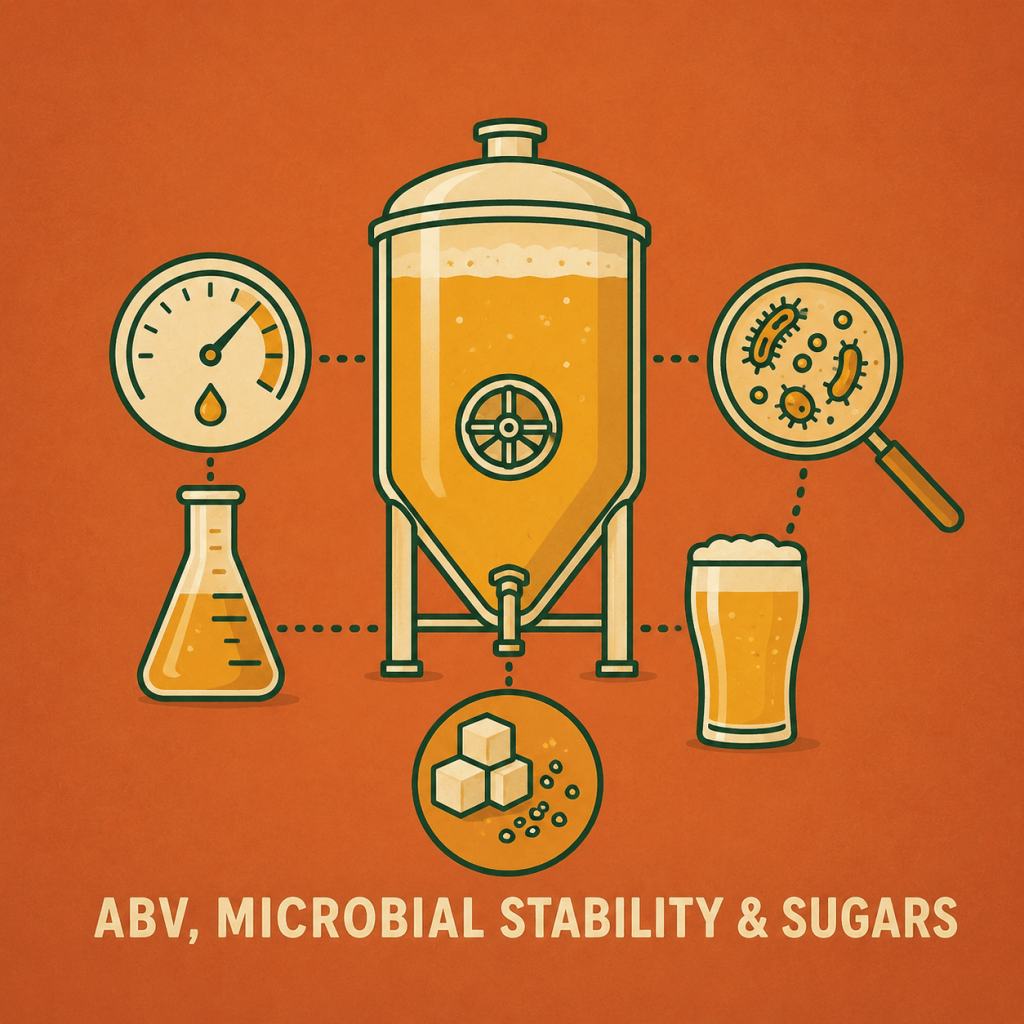
Quality control in beer is often split into separate tests. One test checks alcohol. Another checks microbiology. Another checks fermentation progress. But in real brewing, these topics are closely connected.
ABV, microbial stability, and fermentable sugars tell different parts of the same story. Together, they help the brewer understand whether the beer fermented as expected, whether it is stable, and whether it is safe to package or release.
Looking at only one of these parameters can give an incomplete picture.
Fermentable sugars: what can still happen?
Fermentable sugar measurement tells the brewer what yeast or microorganisms can still consume. This is important because beer can look finished while still containing fermentable material.
A stable gravity reading does not always mean that fermentation is fully complete. Density is affected by alcohol, dextrins, proteins, minerals, and other dissolved compounds. It does not directly show how much fermentable sugar remains.
If fermentable sugars are still present, there may still be a risk. Yeast can continue fermenting. Wild yeast or bacteria can also use sugars and change the beer later.
This can lead to overcarbonation, gushing, alcohol increase, acidity, flavour changes, or instability after packaging.
ABV: what actually happened?
ABV measurement tells the brewer how much alcohol was produced. This is important for quality, labelling, taxation, and consumer trust.
Many breweries estimate ABV from original and final gravity. This is useful, but it is not always accurate. Errors in original gravity, final gravity, temperature correction, or sampling can all affect the calculation. In some beers, high residual extract can also make the calculation less reliable.
A laboratory ABV test gives stronger confirmation.
ABV also helps interpret fermentation performance. If the ABV is lower than expected, fermentation may have been incomplete, the wort may have contained less fermentable sugar, or the yeast may not have performed well. If ABV is higher than expected, the wort may have been more fermentable, the original gravity may have been wrong, or extra sugars may have been created during the process.
ABV shows the result. Fermentable sugars help explain the risk that remains.
Microbiology: who else is in the beer?
Microbial testing helps detect unwanted organisms such as wild yeast or bacteria. This is important because microorganisms can change beer after packaging.
A beer may pass sensory checks and still contain contamination. The problem may only become clear later, when the beer becomes sour, overcarbonated, hazy, or unstable.
Microbial testing becomes even more important when fermentable sugars are present. If there is food available and microorganisms are present, the beer can continue changing.
This is why sugar data and microbiology should be interpreted together. A beer with low fermentable sugars and clean microbiology is lower risk. A beer with higher fermentable sugars and microbial contamination is a much higher risk.
Why these tests should not be isolated
Each test gives useful information, but the real value comes from combining them.
For example, imagine a beer with stable density. Without more information, the brewer may decide it is ready. But if fermentable sugars are still high, there may be a risk of further fermentation. If microbiology also shows wild yeast, the risk becomes much higher. If ABV is lower than expected, it may suggest that fermentation did not reach the intended endpoint.
Another example is a dry-hopped beer. Hop enzymes can create new fermentable sugars from dextrins. Gravity may not clearly show this at first. Fermentable sugar monitoring can detect the change. Microbiology can confirm whether unwanted organisms are present. ABV can later confirm whether additional fermentation occurred.
Together, these measurements tell a much clearer story.
A practical release strategy
Craft breweries can use a simple release strategy. Before packaging or release, check the key risks:
- Is fermentation stable?
- Are fermentable sugars low or at the expected level?
- Does ABV match the label and recipe expectation?
- Is microbiology clean, especially for risk batches?
- Does sensory evaluation match the expected profile?
This does not mean that every batch needs every test. The plan can depend on beer style, packaging format, history, and risk level. For example, a dry-hopped beer, strong beer, non-alcoholic beer, or beer with previous problems may need more checks than a stable core beer with a long production history.
Better confidence, better decisions
ABV, microbial stability, and fermentable sugars belong together because they answer three connected questions.
What happened during fermentation? What can still happen? And is anything unwanted present?
For craft breweries, this combined view is powerful. It supports better release decisions, reduces surprises after packaging, and helps protect product quality.
Good quality control is not only about testing. It is about understanding the beer well enough to make the right decision at the right time.
 English
  Nederlands