
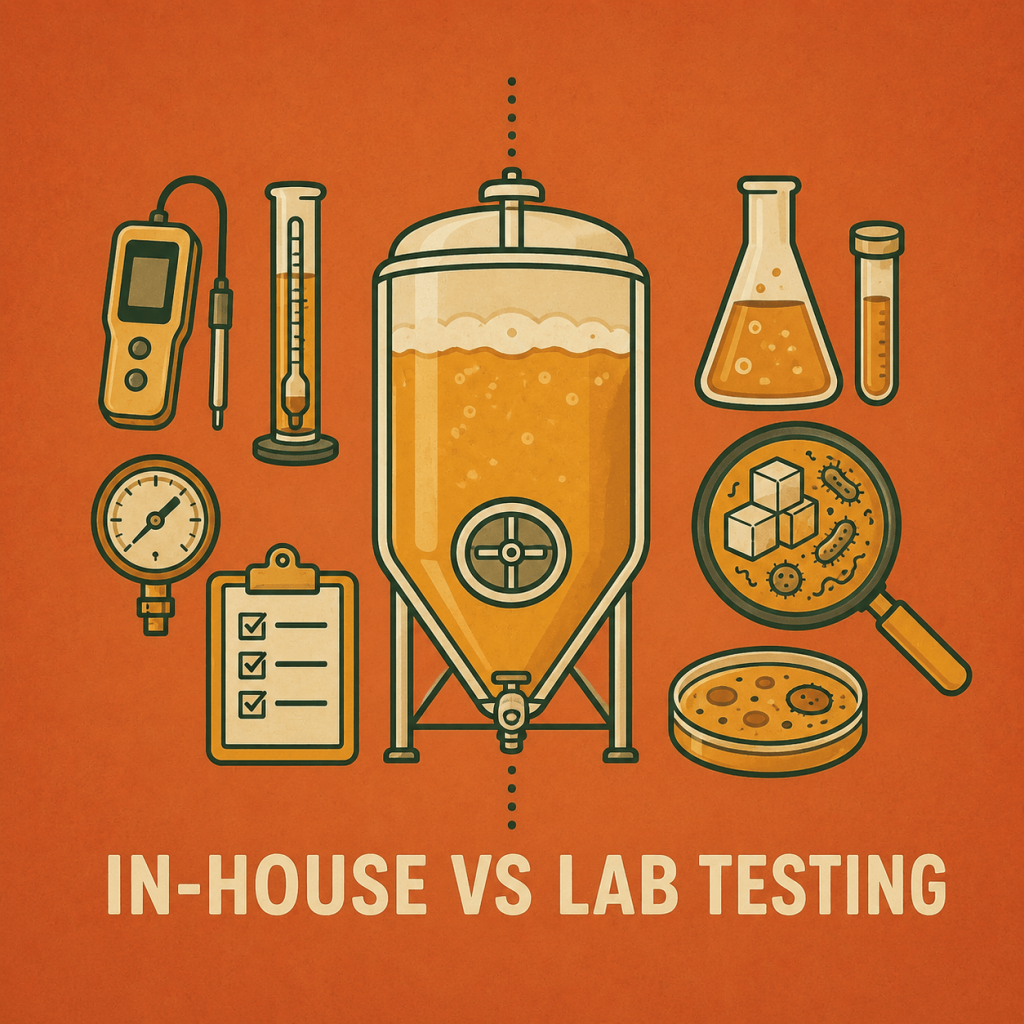
Not every craft brewery needs a full laboratory. In fact, for many breweries, building and managing a complete lab is too expensive and too time-consuming. But every brewery needs quality control.
The practical question is not “Should we test?” The real question is: “What should we test ourselves, and what should we send to a specialised lab?”
A smart testing plan can give a brewery good information without creating too much overhead.
What makes sense to measure in-house?
In-house testing is most useful when the result helps the brewer make a quick production decision. These are tests that should be close to the process and easy to repeat.
Good examples are pH, density, temperature, and fermentable sugars.
pH helps the brewer follow mash performance, fermentation behaviour, and final beer stability. Density gives a general view of fermentation progress. Temperature is essential for yeast control and flavour development.
Fermentable sugars give more direct information about what yeast can still consume. This is especially useful during fermentation, after dry hopping, and before packaging. Density may look stable while fermentable sugars are still present. Measuring sugars directly gives the brewer more confidence.
These tests are valuable because they support daily decisions. Is the mash performing well? Is fermentation moving? Is the beer ready for dry hopping? Is it safe to package? Should the brewer wait longer?
In-house measurements help answer these questions quickly.
What is better to check in the lab?
Some tests are better performed by a specialised laboratory. This is especially true when the test requires advanced equipment, trained interpretation, or a more formal method.
ABV is a good example. Many breweries calculate alcohol from original and final gravity. This is useful as an estimate, but it can be wrong. Measurement errors, recipe changes, residual extract, alcohol effects, and incomplete fermentation can all influence the result. A lab ABV measurement gives a stronger confirmation of the final product.
Microbiological testing is another important lab check. Contamination is not always visible. A beer can taste fine today but still contain wild yeast or bacteria that cause problems later. Microbial testing helps confirm hygiene and product stability.
Other useful lab checks include IBU, colour, dissolved oxygen, CO₂, FAN, VDK, DMS, or troubleshooting analysis. These tests do not always need to be done on every batch. They can be planned based on risk, beer style, customer requirements, or production changes.
A practical testing model
A brewery can use a simple three-step model.
The first step is routine production control. These are in-house checks during brewing and fermentation: pH, density, fermentable sugars, temperature, and sensory observations.
The second step is release control. These are checks before packaging or before product release. This can include final fermentable sugars, final density, sensory approval, ABV confirmation, and selected microbiological testing.
The third step is investigation. These tests are used when something unusual happens. For example, if fermentation is slow, ABV is different than expected, beer is unstable, or contamination is suspected.
This model keeps the workload realistic. The brewery does not need to test everything all the time. It only needs to collect the right information at the right moment.
Why this matters
Good testing is not about collecting numbers. It is about making better decisions.
In-house checks give fast process information. Lab checks give deeper confirmation and expert interpretation. Together, they help the brewery reduce risk, improve consistency, and understand its own process better.
For craft breweries, this is a practical way to professionalise quality without building a large internal lab. The brewery keeps overhead low but still gains reliable information.
This is especially important when the brewery grows. More production means more responsibility. A smart testing plan helps the team stay organised, protect product quality, and scale with confidence.
 English
  Nederlands