
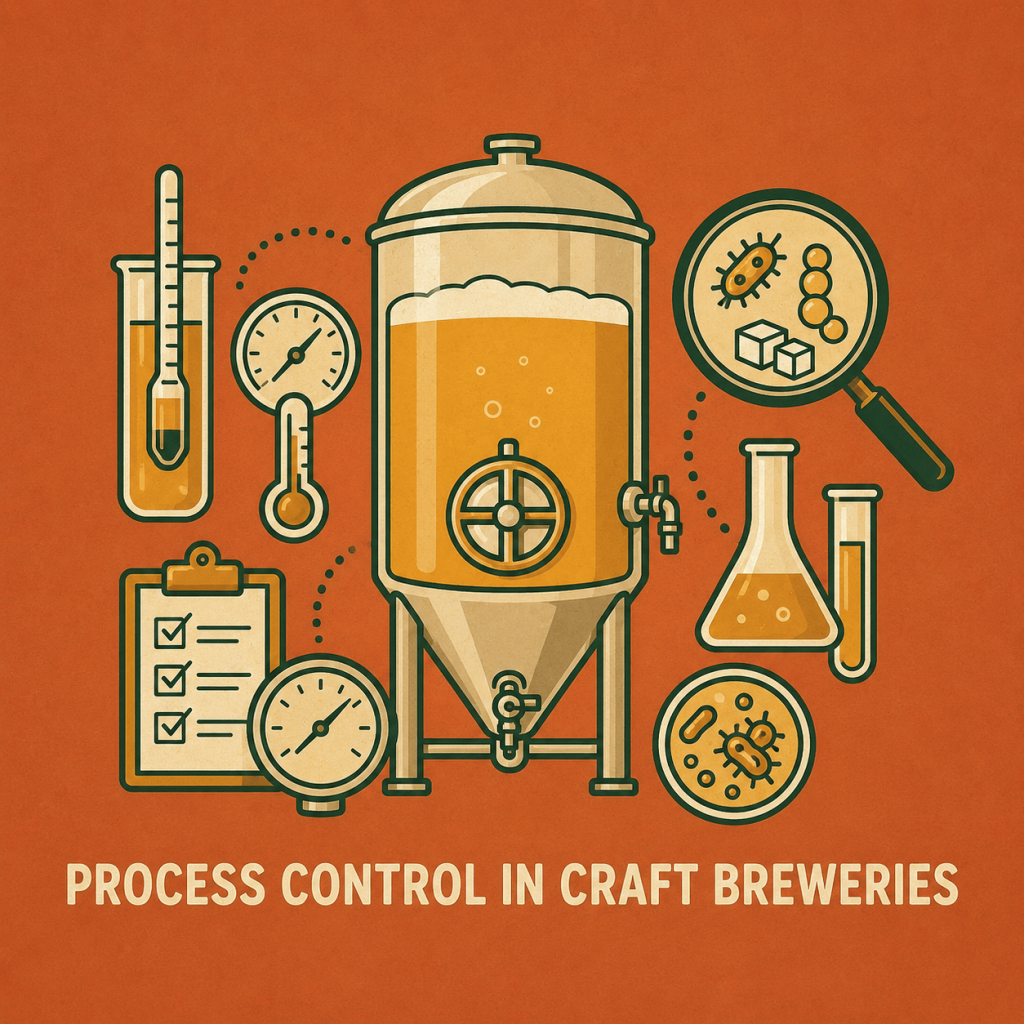
Craft breweries are often built on creativity, speed, and flexibility. Brewers want to make interesting beers, respond to customer demand, and keep tanks moving. But as production grows, quality control becomes more important. A brewery cannot rely only on experience, taste, and “this is how we usually do it”.
Good process control does not mean that every craft brewery needs a large laboratory or a full-time quality manager. It means that the brewery has a clear plan: what to measure, when to measure it, how to record the data, and how to use the results.
This is especially important when the brewery is busy, tank space is limited, and decisions need to be made quickly.
Why process control matters
Many brewing problems are only discovered at the end of the process. A beer may ferment too far, not ferment enough, develop contamination, have a wrong alcohol level, or become unstable after packaging. At that moment, it is often too late to fix the problem.
Process control helps move quality decisions earlier in the process. Instead of asking, “What went wrong?” after the beer is finished, the brewer can ask, “Is this batch still moving in the right direction?” while there is still time to react.
For craft breweries, this is very valuable. It reduces waste, protects product quality, and helps avoid surprises with customers.
What can be controlled in the brewery?
Some measurements are very useful to perform directly in the brewery. They do not need to be complicated, but they should be done consistently.
During mashing and wort production, the brewery can check extract development, pH, and fermentable sugars. This helps confirm whether the mash is performing as expected and whether the wort will support the intended fermentation profile.
During fermentation, the brewery can follow density, pH, temperature, and fermentable sugars. Density gives a general picture of fermentation progress, but fermentable sugar measurement gives more direct information about what yeast can still consume. This is especially useful for dry-hopped beers, strong beers, low-alcohol beers, and batches that need to be packaged quickly.
Before packaging, the brewery can check whether fermentation is completed, whether fermentable sugars are at a safe level, and whether the beer profile matches expectations. These checks help the brewer decide whether the beer is ready or whether it needs more time.
These in-house measurements create a process fingerprint. Over time, the brewery learns what normal looks like for each beer.
What is better to check in the lab?
Not every test needs to be done in-house. Some tests are better performed by a specialised lab, especially if they require more advanced equipment, trained interpretation, or official methods.
Alcohol by volume is a good example. Many breweries estimate ABV from original and final gravity. This can be useful, but it is not always accurate. Recipe changes, incomplete mixing, alcohol effects, residual extract, and measurement errors can all influence the calculation. A laboratory ABV measurement gives a stronger confirmation of the final product.
Microbiological testing is another important lab check. A beer can look, smell, and taste normal while still containing unwanted microorganisms. Wild yeast, lactic acid bacteria, or other contaminants can cause problems later, especially after packaging. Microbial testing helps confirm product stability and hygiene performance.
Other useful lab checks can include IBU, colour, FAN, dissolved oxygen, CO₂, VDK, DMS, or more detailed troubleshooting tests. The key point is not to test everything all the time. The key point is to choose the right tests for the right risk.
How to plan testing without too much overhead
A good quality plan should fit the size of the brewery. It should not create unnecessary work. For many craft breweries, a simple three-level system works well.
The first level is routine in-house control. These are fast checks during production: pH, density, fermentable sugars, temperature, and basic observations. They help the brewer make daily decisions.
The second level is release control. These are checks before packaging or before product release. They may include fermentable sugars, final density, sensory evaluation, ABV confirmation, and microbiological testing for selected batches.
The third level is investigation and improvement. These tests are used when something is unusual: fermentation is slow, ABV does not match expectations, the beer is unstable, or contamination is suspected. This is where lab support and expert interpretation become very useful.
This structure keeps overhead low. The brewery does not need to test everything in every batch. Instead, it creates a smart routine that gives useful information at the right moment.
Data is only useful when it is interpreted
Collecting numbers is not enough. The real value comes from understanding what the data means.
For example, a stable gravity reading may suggest that fermentation is finished. But if fermentable sugars are still present above guideline value, there may still be a risk of further fermentation. A small pH change may be normal in one beer but suspicious in another. A microbial result may need to be interpreted together with beer style, packaging format, and shelf-life expectations.
This is why good organisation matters. Results should be linked to the batch, recipe, date, tank, process step, and any special observations. Over time, this creates a useful history. The brewery can compare batches, detect patterns, and improve decisions.
Without proper records, the same problem can happen again and again. With good records, every batch becomes a learning opportunity.
Better quality and better organisation
For craft breweries, process control is not only about avoiding bad beer. It is also about becoming better organised.
A brewery with a clear testing plan can release beer with more confidence. It can explain quality decisions to customers, distributors, investors, or partners. It can train new staff more easily. It can scale production without losing control. It can also adapt faster when recipes, raw materials, yeast, or market demands change.
This is important because growth often creates pressure. More beer, more tanks, more packaging days, and more customers mean less room for guesswork. A simple quality system helps the brewery stay creative while becoming more professional.
The practical advantage
Good process control does not need to be complicated. It needs to be planned, consistent, and useful.
In-house measurements give fast information during production. Lab checks give confirmation and deeper insight. Together, they help the brewer understand what is happening, prevent problems, and make better decisions.
For craft breweries, this means less overhead than building a full lab, but much better control than relying only on taste and tradition. It supports product quality, protects reputation, and prepares the brewery for growth.
In the end, process control is not about making craft beer less creative. It is about giving brewers the information they need to keep making great beer, batch after batch.
 English
  Nederlands