
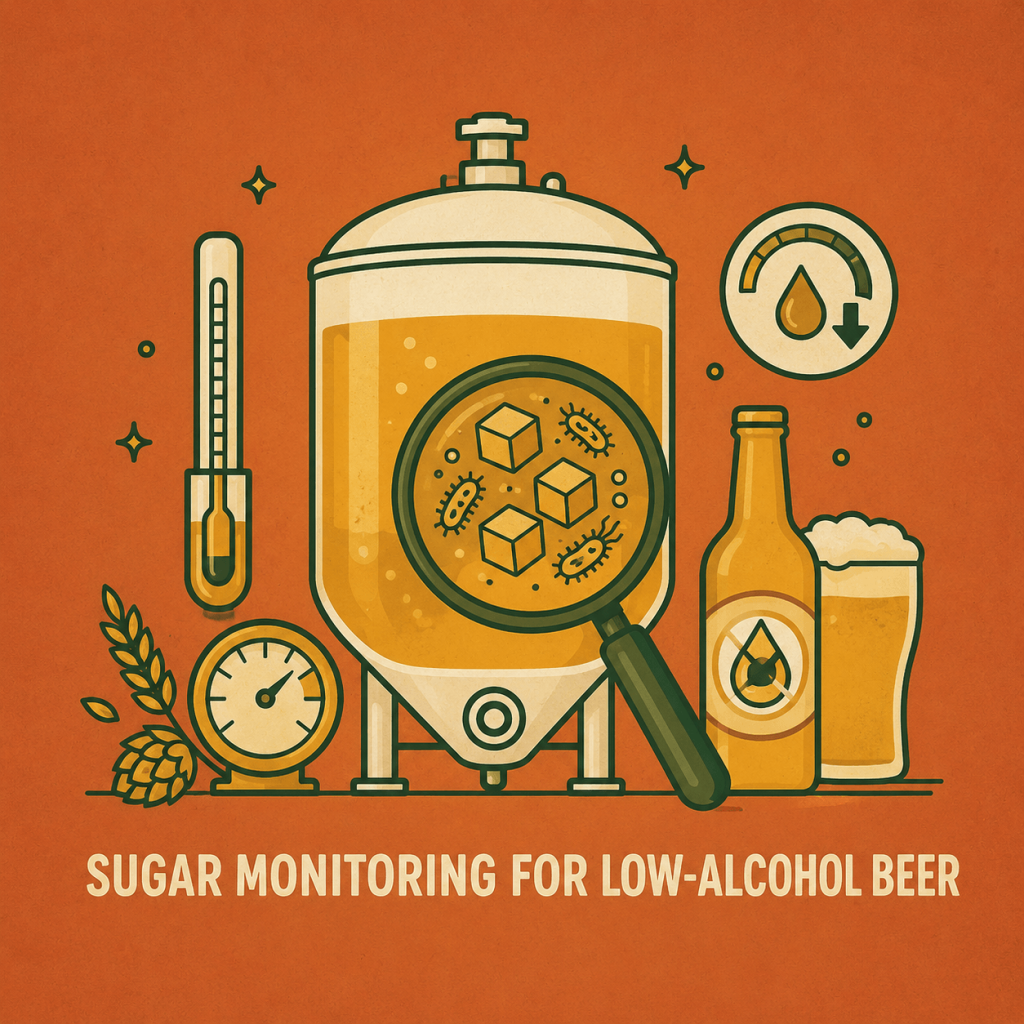
Non-alcoholic and low-alcohol beers are becoming more popular, but they are also technically difficult to produce. The brewer needs to create flavour, body, and balance, but at the same time must keep alcohol formation under control. This is not easy, because beer flavour normally comes from fermentation, and fermentation always starts with yeast consuming fermentable sugars.
For this reason, measuring fermentable sugars can be very valuable in non-alcoholic and low-alcohol beer production. It gives the brewer a clearer view of how much sugar is still available for yeast and how much alcohol could still be formed.
Why gravity is not enough
In normal beer production, density measurements are often used to follow fermentation. A drop in gravity shows that yeast is active and that sugars are being converted into alcohol and CO₂. But in non-alcoholic and low-alcohol beer, the situation is more sensitive.
The difference between a correct alcohol level and a beer that is above the legal or label limit can be small. A small mistake in process control can lead to too much alcohol. Density measurements may not be precise enough to manage this risk, especially when the alcohol target is very low.
Density is also influenced by many compounds, not only fermentable sugars. Proteins, dextrins, minerals, acids, and other dissolved materials can affect the reading. In non-alcoholic beers, where the brewer may use special mashing profiles, limited fermentation, stopped fermentation, dilution, or dealcoholisation, density can become difficult to interpret.
A stable or expected gravity value does not always mean that the sugar profile is safe.
The challenge of limited fermentation
One common way to make low-alcohol beer is to limit fermentation. The brewer may use a special yeast strain, a short fermentation time, a low fermentation temperature, or a wort with reduced fermentability.
This requires very good timing. If fermentation continues too long, the alcohol level may become too high. If it is stopped too early, the beer may taste too sweet, worty, or unbalanced. The brewer needs to know not only that fermentation is happening, but how much fermentable sugar is being consumed.
Direct fermentable sugar measurement helps answer this question. It shows whether yeast is still consuming sugars, whether the process is slowing down, and how much fermentable material remains in the beer.
This is especially useful when the brewer is working with a new yeast, a new recipe, or a new production method.
Risk after packaging
Non-alcoholic and low-alcohol beers can be more sensitive to microbiological and fermentation risks. If fermentable sugars remain in the beer, and if yeast or other microorganisms are still present, fermentation can continue later.
This may happen in the tank, in the keg, or even after packaging. The result can be unwanted alcohol increase, overcarbonation, flavour changes, haze, or product instability.
For a normal beer, a small amount of additional fermentation may not always be noticed immediately. For a non-alcoholic or low-alcohol beer, it can be a serious problem. It may affect label compliance, product safety, and consumer trust.
Measuring fermentable sugars before packaging gives the brewer an extra safety check. It helps show whether the beer still contains material that can be converted into alcohol.
Better control of sweetness and body
Non-alcoholic beer often needs some residual sweetness and body to avoid a thin or watery profile. However, the brewer needs to know what kind of sweetness is present.
There is a big difference between non-fermentable body-building compounds and fermentable sugars that yeast can still consume. Density alone does not clearly separate these two groups.
Fermentable sugar monitoring helps the brewer understand whether the beer is stable or whether it still contains sugars that can drive further fermentation. This gives better control over flavour, stability, and alcohol formation.
A practical tool for process development
When developing non-alcoholic and low-alcohol beers, brewers often need several trials. They may test different mash temperatures, yeast strains, fermentation times, dilution rates, or dealcoholisation strategies.
Measuring fermentable sugars during these trials gives useful data. It helps compare batches and understand why one version works better than another. It also supports better decisions when scaling up from pilot batch to full production.
Instead of relying only on taste, gravity, and final alcohol measurement, the brewer can follow the sugar profile during the process.
Why it gives an edge
Non-alcoholic and low-alcohol beer production is a balance between flavour, alcohol control, and product stability. Small mistakes can have big consequences.
Fermentable sugar monitoring gives brewers more control over this balance. It helps detect risks before the beer is packaged. It supports better timing, better recipe development, and better quality control.
For breweries entering the non-alcoholic or low-alcohol market, this can be a real advantage. The process becomes less of a guess and more of a controlled production method.
In this category, measuring fermentable sugars is not only useful. It can be one of the most important tools for making a stable, tasty, and compliant beer.
 English
  Nederlands