
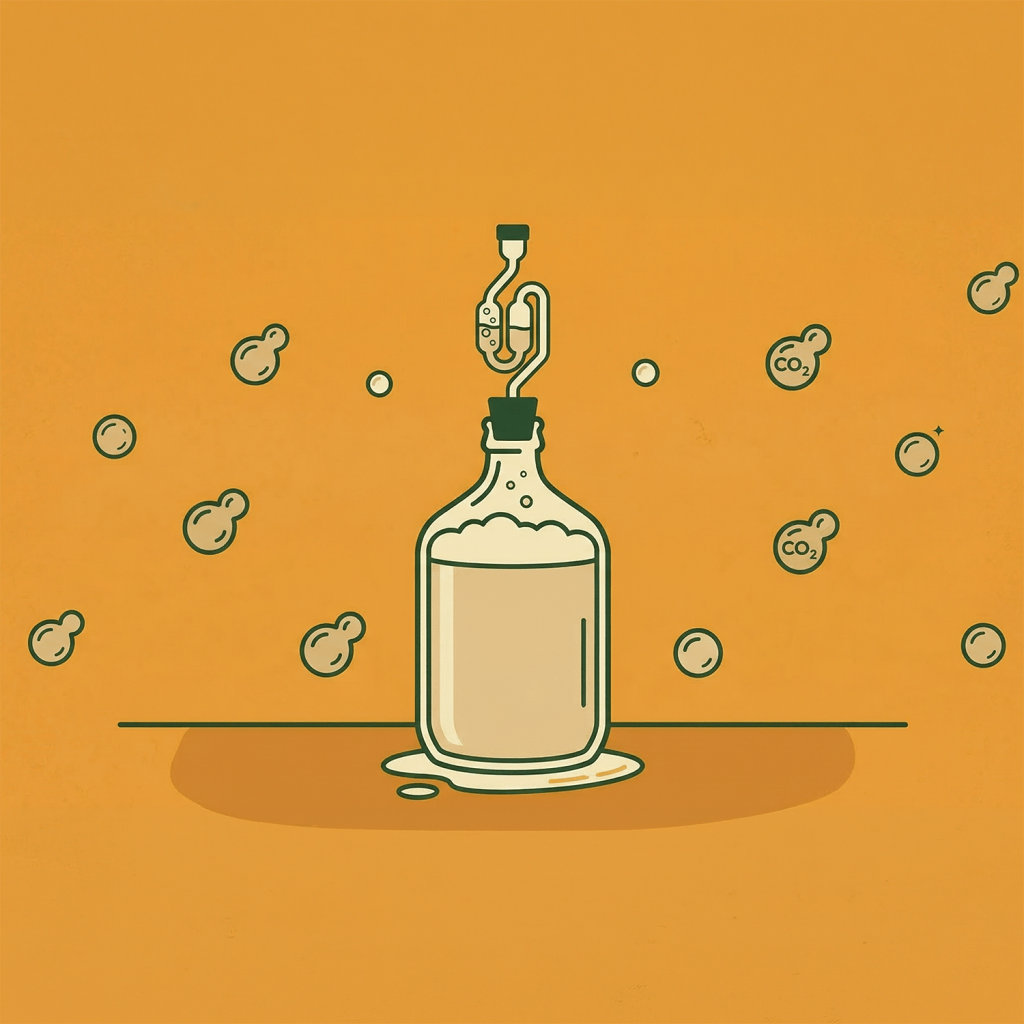
The Most Common Packaging Mistake in Craft Brewing
One of the most common questions brewers ask is surprisingly simple:
When is fermentation actually finished?
Many brewers believe they already know the answer. If the airlock stops bubbling and the gravity seems stable, fermentation must be complete. The beer looks calm, the yeast has settled, and the fermentation schedule says it is time to package.
Yet this assumption is responsible for many problems in breweries around the world.
Over-carbonated bottles, unexpected alcohol levels, and unstable beer on the shelf are often caused by one simple issue:
The beer was packaged before fermentation was truly finished.
Understanding when fermentation has really ended is one of the most important skills for controlling beer quality.
The Illusion of Finished Fermentation
Fermentation is a biological process. Yeast converts fermentable sugars into alcohol and carbon dioxide, but it does not always follow the brewer’s production schedule.
In many breweries, fermentation is judged by a few visual signals:
- airlock activity has stopped
- the gravity looks stable (same reading 48h apart)
- yeast has settled
- the beer appears clear
These signs can be useful, but they are not always reliable indicators of fermentation completion.
Yeast often slows down significantly near the end of fermentation. At this stage only a small amount of fermentable sugar remains. Because the activity is slow, it may appear that fermentation has stopped, even though the yeast is still working.
If the beer is packaged at this point, the yeast can continue fermenting the remaining sugars later in the bottle or can. This is where problems begin.
What Happens When Beer Is Packaged Too Early
Packaging beer before fermentation is finished can cause several issues. The most common one is over-carbonation. When yeast continues fermenting inside a sealed container, it produces additional carbon dioxide. Because the container is closed, the pressure increases.
This can lead to:
- beer that foams excessively
- bottles or cans with higher pressure than expected
- inconsistent carbonation between batches
- in extreme cases, bottle bombs
Another consequence is unexpected alcohol levels. If fermentation continues after packaging, the alcohol content may increase slightly beyond the calculated value. For breweries that need accurate ABV labelling, this can become a regulatory issue.
Finally, unfinished fermentation can also affect flavour stability. Yeast activity inside the package may change the flavour profile over time. These problems are frustrating because they often appear weeks after the beer has left the brewery.
Why Gravity Measurements Can Be Misleading
Many brewers rely on gravity measurements to determine when fermentation has finished. The typical rule is simple: if gravity remains stable for one or two days, fermentation is complete. However, this method has limitations.
Gravity measurements show the density of the beer, which decreases as sugar is converted into alcohol. But near the end of fermentation, changes in gravity become very small. If measurements are taken only once per day, these small changes may not be visible. The beer may appear stable even though a small amount of fermentable sugar remains.
In addition, measurement errors can make it difficult to detect subtle differences in gravity. Because of these limitations, gravity alone does not always provide a clear answer about fermentation completion.
Residual Fermentable Sugars: The Hidden Factor
The real question is not only whether fermentation has slowed down, but whether fermentable sugars are still present in the beer and if yeast can consume them?
Even a small amount of active yeast can cause problems after packaging.
This is especially relevant for modern beer styles such as:
- hazy IPAs
- high-gravity beers
These beers often contain complex sugar profiles and active yeast populations that can continue working longer than expected. If the brewer cannot measure the remaining fermentable sugars, it becomes difficult to know whether fermentation has truly reached its endpoint.
How Breweries Confirm the End of Fermentation
Professional breweries use several methods to confirm fermentation completion. The simplest approach is repeated measurement over time. By tracking fermentation data closely, brewers can observe whether the process is still progressing.
More advanced methods allow to measure specific fermentable sugars to confirm that yeast no longer has fuel available or is not capable of processing it. These measurements provide a much clearer picture of fermentation status than visual signals alone. Instead of asking whether fermentation appears finished, brewers can ask a more precise question:
Are yeast still capable of fermenting?
When the answer is no, fermentation is truly complete.
Why Fermentation Control Improves Beer Quality
Confirming the end of fermentation may seem like a small technical detail, but it has a major impact on beer quality and process stability. Breweries that control fermentation completion gain several advantages:
- Carbonation becomes more predictable because the beer is packaged at the correct stage.
- Alcohol levels become more consistent between batches.
- Shelf stability improves because yeast activity inside the package is minimized.
Most importantly, the brewery gains confidence that the product leaving the facility will behave the same way in the market. Consistency is one of the most valuable assets a brewery can have.
The Difference Between Guessing and Knowing
Many brewing decisions are still based on experience and intuition. This is part of what makes brewing both an art and a science. However, when it comes to fermentation completion, relying only on visual signals can introduce unnecessary risk.
A beer that looks finished is not always finished. The difference between guessing and knowing is often a simple measurement. And once brewers begin to monitor fermentation completion more closely, something interesting usually happens: many of the mysterious carbonation and stability issues disappear.
What once looked like random brewing problems turns out to be a matter of understanding the final steps of fermentation. Because in brewing, the moment fermentation truly ends is not always when it appears to. And knowing that moment can make the difference between unpredictable beer and consistent quality.
 English
  Nederlands