
Alcohol content is one of the defining characteristics of beer. It influences flavour balance, body, and drinking experience. For breweries, alcohol content is also an important legal parameter that must be labelled accurately on packaging.
But how do brewers actually measure alcohol content in beer?
Many people assume alcohol content is simply calculated from the recipe. If the brewer knows how much sugar is in the wort and how efficiently the yeast ferments it, the alcohol level should be predictable. While this reasoning makes sense in theory, fermentation rarely behaves exactly the same way every time.
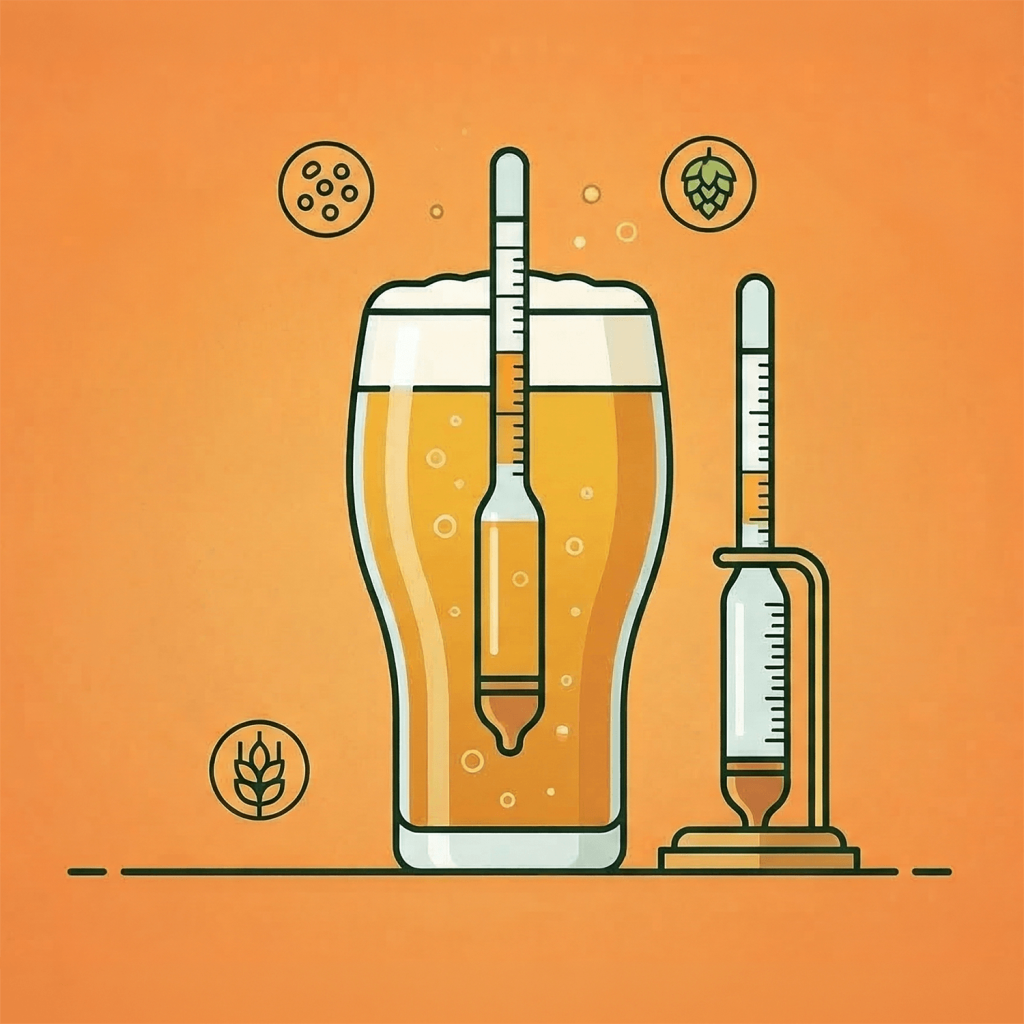
In practice, brewers use measurements to determine alcohol content. The traditional method is based on gravity measurements. Before fermentation begins, brewers measure the density of the wort. This measurement is known as the original gravity. Because wort contains dissolved sugars extracted from malt, it is denser than water.
During fermentation, yeast consumes these sugars and converts them into alcohol and carbon dioxide. Alcohol is less dense than water, so as fermentation progresses the density of the liquid decreases. Once fermentation has finished, brewers measure the density again. This value is called the final gravity.
By comparing original gravity and final gravity, brewers can calculate the approximate alcohol content of the beer. This approach has been used for centuries and remains widely applied in craft brewing.
However, gravity-based calculations assume that fermentation behaves exactly as expected. In reality, differences in fermentation performance can affect the final alcohol level. For example, yeast health, fermentation temperature, and wort composition all influence how efficiently sugars are converted into alcohol.
If fermentation stops earlier than expected, the alcohol content may be lower than calculated. If fermentation continues longer, the alcohol level may be slightly higher. For breweries that must comply with alcohol labelling regulations, these differences can become significant. Modern breweries therefore often use laboratory methods to measure alcohol content more directly.
Techniques such as distillation or densitometry separate alcohol from the rest of the beer and determine its concentration with high precision. These measurements are especially important for breweries that export beer or operate in markets with strict alcohol regulations.
Beyond legal compliance, alcohol measurement provides valuable information about fermentation performance. If measured alcohol levels consistently differ from calculated values, it may indicate that fermentation management needs adjustment. Perhaps yeast health needs improvement, fermentation temperature needs control, or residual sugars remain in the beer. By analysing alcohol content regularly, brewers gain deeper insight into how fermentation behaves in their brewery.
In the end, measuring alcohol in beer is not only about labelling accuracy. It is also about understanding the fermentation process and ensuring that each batch of beer meets the brewer’s expectations.
 English
  Nederlands