
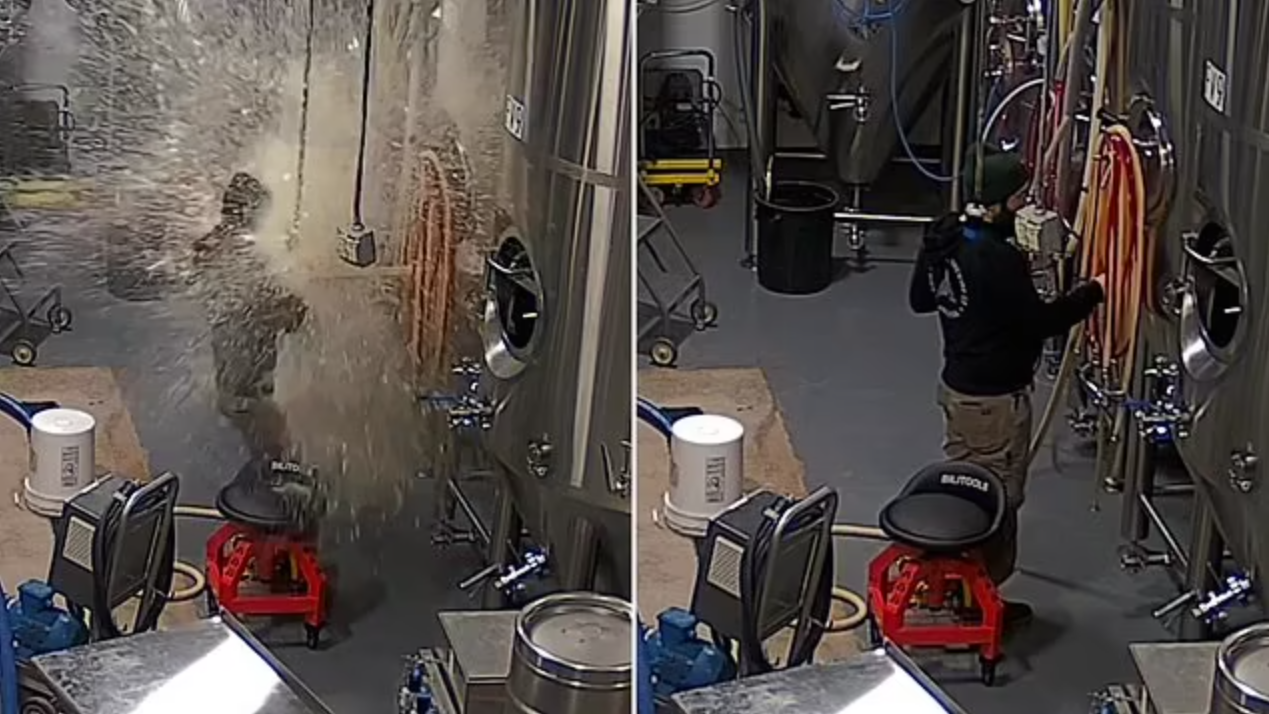
Sweet victory or a painful lesson - what might have become of the microbrewery that was asked to brew 600 kegs of beer for the Olympic Games in Paris last summer? An opportunity to seize with both hands, though not without risk. You only get one shot at it! You do not want to imagine delivering beer of questionable quality at an occasion like that. Picture showing up with dodgy kegs for the organisers of such an exclusive event. That is a nightmare for everyone involved, not least the brewer.
Beer bombs
But then the first reports came in. Is it normal for beer cans to burst open and explode in the pantry or the fridge? Great, just what you need - beer with a mind of its own. Out with the cloth and soapy water to clean up the mess. People have better things to do. Not exactly great advertising for whoever gave them this 'beer bomb'. And for the brewer who made it: a cold shower.
It happens. But can you prevent it?
It is worth first looking for an answer to the question: how does this happen?
One cause may be that fermentation was not yet complete at the moment the unfortunate brewer in the example above filled the beer. If fermentable sugars are still present in the beer, fermentation simply continues after filling. Some brewers have built their reputation on exactly this. It is the secret of Belgian breweries whose fame rests on bottle-conditioned beer. But they have the technology and experience to let this process run in a controlled, accident-free manner. Brewers who unknowingly fill beer that is still fermenting can end up with bottles, cans, or kegs in which pressure builds up - until they explode.
Out of control
Brett, Lactobacillus… These can be ingredients for speciality beers that delight enthusiasts - provided brewers keep their effects under control. If that is not the case, contamination with wild yeasts or bacteria can lead to unwanted fermentation. As a result, additional CO₂ production simply 'carries on' after filling, causing pressure inside the bottle, can, or keg to find an outlet you definitely do not want - as a brewer, retailer, or consumer.
A third reason for exploding beer cans can be excessive CO₂ pressure. Unfortunately, this is a common occurrence in beer from microbreweries: overcarbonation. There is too much carbon dioxide in the beer. Often the result of inadequate process control - measurements could have been more precise and consistent. And too much CO₂ causes excessive pressure.
Keep control
Another - and perhaps more interesting - question is: can you as a microbrewer actually prevent this? The answer is: for the most part, yes. If you carry out good quality measurements, the risk of exploding cans, bottles, or kegs can be kept well in check.
So what should you measure as a brewer?
pH
First piece of advice: keep an eye on pH. By knowing how acidity develops, you as a brewer can prevent the growth of microbes and contamination with unwanted organisms. It also helps you identify spoilage risks early, so you can make adjustments before filling.
TFS
It is also worth measuring Total Fermentable Sugar (TFS) during the brewing process. This lets you detect residual sugars that could lead to unwanted refermentation after filling, and ensures that fermentation is truly complete at the time of filling. Testing for remaining fermentable sugars also helps prevent your beer from becoming sweeter than intended, and protects you against carbonation problems caused by unconverted sugars in the beer.
ABV
A third parameter to test is alcohol content. Measuring it accurately helps confirm that fermentation is complete and stable - which is the essential prerequisite for ensuring that no additional alcohol or CO₂ develops in your beer after filling. Testing ABV has an added benefit: you have certainty about the alcohol level to comply with regulations and quality standards, and - not least - to meet your customers' need for a consistent product.
EBC
Finally, it is useful to measure the colour of the beer you have brewed: EBC. This lets you check the quality consistency across different batches of the same beer, which in turn is a valuable indicator of the correct degree of attenuation and raw material quality control. Colour measurements allow you to detect unwanted colour deviations that may point to oxidation or contamination - both of which can cause an unstable product, leading to exploding or bursting cans, for example.
Measure smart
All in all, there are several good reasons to take measurement seriously if you want beer of the very best quality. And perhaps it is already standard practice in your brewery. If so: congratulations! But pause for a moment and consider another question: are you doing it smartly enough? Do quality measurements cost more time and money than you would like?
If something is nagging at you because you feel it could be done better, we should have a conversation. Because we have a solution for you: Beer-o-Meter. With it you perform laboratory-level quality tests - Total Fermentable Sugar, pH, EBC, and ABV - in-house, with the fastest possible turnaround. Yet precise, with as little effort as possible. Because a successful brewer knows exactly what they are doing. And spares their customers from exploding bottles, bursting cans, or rogue kegs.