
Brewers are busy people. On the same day, they may need to brew, clean, transfer beer, dry hop, package, answer emails, receive ingredients, and solve equipment problems. In this environment, quality control can feel like another task on an already full list.
But quality control does not need to be complicated. Small checks at the right moments can prevent big problems later.
The key is to build a simple routine that gives useful information without slowing down the brewery.
Why small errors become big problems
In brewing, small errors can grow over time. A mash that produces a different sugar profile can lead to a different fermentation. A slow fermentation can delay packaging. A beer with too much fermentable sugar can continue fermenting in the package. A small contamination can become a serious shelf-life problem.
Often, these issues are not visible immediately. The beer may taste fine today but change later. It may look stable in the tank but become overcarbonated in the bottle or can. It may have an ABV that does not match the label.
This is why basic checks are important. They help detect risks while there is still time to react.
Check the process, not only the final beer
Many breweries focus mainly on the final product. They taste the beer, check the final gravity, and decide whether it is ready. This is important, but it is not enough.
Quality should be followed during the process. The earlier a problem is found, the easier it is to correct.
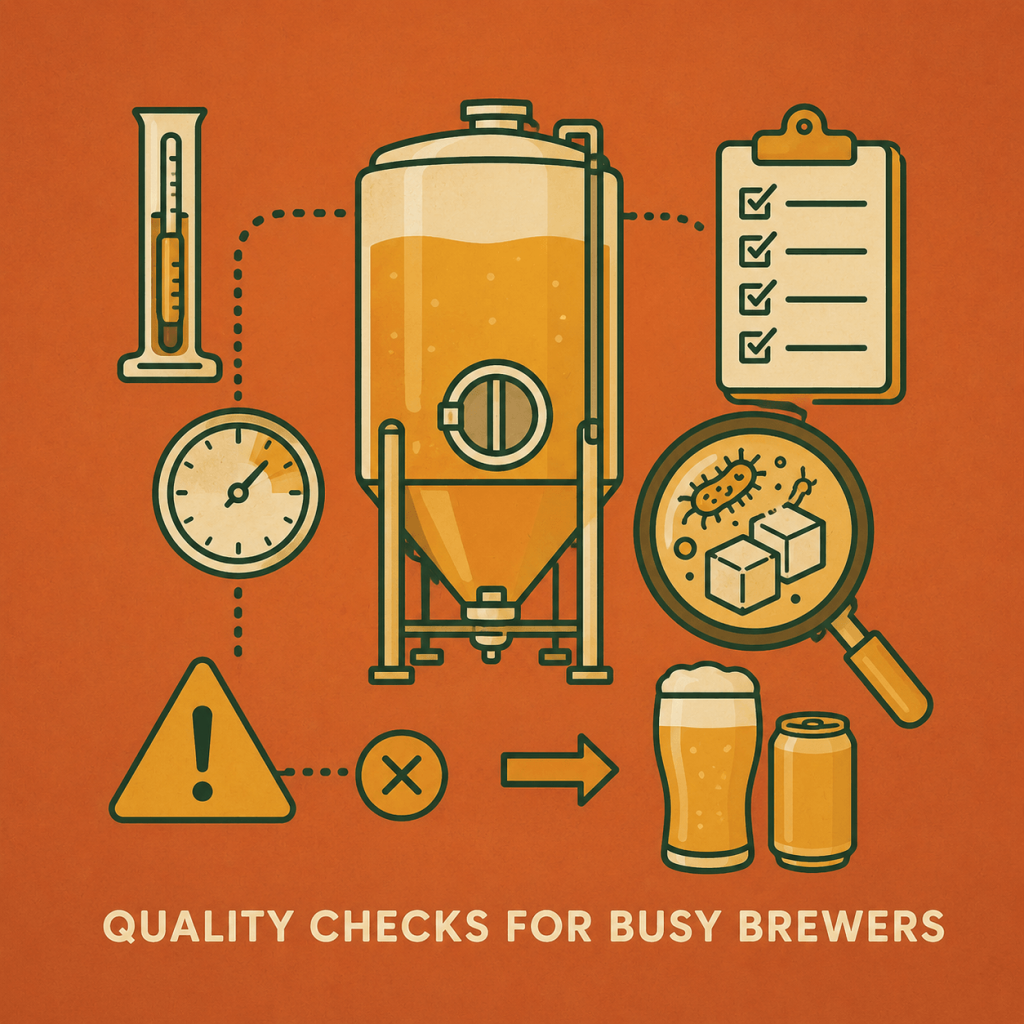
During mashing, pH and fermentable sugars can show whether the wort is developing as expected. During fermentation, density, pH, temperature, and fermentable sugars can show whether yeast is performing normally. After dry hopping, fermentable sugar measurement can help detect hop creep risk. Before packaging, final checks can help confirm that the beer is stable.
These checks do not need to be difficult. They just need to be planned.
Useful checkpoints for a busy brewery
A practical routine could include a few key moments.
First, check the wort. Measure original gravity, pH, and fermentable sugars. This gives a baseline for the fermentation.
Second, check active fermentation. Follow density and fermentable sugars. This shows whether yeast is consuming sugars as expected.
Third, check after dry hopping or other additions. This is important because dry hopping can change the beer and sometimes create new fermentable sugars.
Fourth, check before packaging. Confirm that fermentation is stable, fermentable sugars are at a safe or expected level, and sensory quality is good.
Fifth, use lab checks when needed. ABV and microbiology are especially useful for release control, troubleshooting, and higher-risk beers.
This type of routine gives useful information without creating too much work.
Keep records simple
Measurements are much more valuable when they are recorded properly. A notebook, spreadsheet, or digital system can work, as long as the information is easy to find.
Each result should be linked to the batch, tank, date, process step, and beer name. Comments are also useful. For example: “dry hopped today”, “fermentation slower than usual”, “sample very turbid”, or “temperature higher than planned”.
These notes help with interpretation. A number without context is often not enough. A number with context can explain what happened.
Over time, records help the brewery learn. The team can see which beers are consistent, which recipes need attention, and which process steps create risk.
Less overhead, more confidence
Good quality control should make life easier, not harder. For busy breweries, the best system is one that gives clear information with limited extra work.
In-house checks can support quick decisions. Lab checks can provide confirmation and deeper insight. Together, they help the brewer avoid surprises.
This is especially useful when the brewery is under time pressure. If a beer needs to be packaged soon, good data can support the decision. If the data shows risk, the brewer can wait or take action. Either way, the decision is better informed.
Small checks protect the brand
Every batch carries the brewery’s name. Customers may forgive one small difference, but repeated quality problems damage trust. Gushing bottles, unstable cans, wrong ABV, or infected beer can quickly become expensive and stressful.
Small quality checks help protect the product and the brand. They also help the brewery become more organised and ready to grow.
Quality control is not only for large breweries. It is for every brewery that wants to make good beer consistently.
For busy brewers, the goal is simple: measure the right things at the right moments, understand the results, and act before small problems become big ones.
 Nederlands
  English