
Yeast management is one of the most important parts of brewing. Healthy yeast can create a clean, controlled, and predictable fermentation. Stressed or insufficient yeast can lead to slow fermentation, off-flavours, incomplete attenuation, or unstable beer.
In some cases, fermentation does not progress as expected and the brewer needs to repitch yeast. This can happen once, or in difficult cases even multiple times. When this happens, measuring fermentable sugars can be extremely useful.
It helps the brewer understand whether repitching is needed, whether it worked, and whether the beer is finally safe to move forward.
Why repitching is not always simple
Repitching yeast sounds like a straightforward solution: if fermentation slows down, add more yeast. In practice, it is more complicated.
The brewer first needs to understand why fermentation slowed down. Was the original pitch too low? Was the yeast old or stressed? Was the wort too high in gravity? Was there a nutrient limitation? Was the fermentation temperature too low? Did alcohol stress stop the yeast? Or was the beer already almost finished?
Without good information, repitching can become guesswork.
If the brewer repitches too early, it may not be necessary. If the brewer repitches too late, the beer may already have developed problems. If the brewer repitches without understanding the remaining fermentable sugar level, it is difficult to judge whether the new yeast has a real chance to improve the situation.
The limits of gravity during slow fermentation
When fermentation becomes slow, density measurements may not give enough detail. A small gravity drop over several days can be difficult to interpret. It may mean that yeast is still active, but slowly. It may also mean that the process is almost stopped.
In some beers, especially strong beers or beers with a lot of non-fermentable extract, the final gravity can remain high even when fermentation is complete. In other cases, the gravity may look almost stable while fermentable sugars are still present.
This is where direct fermentable sugar measurement gives more useful information. It shows whether there is still sugar available for yeast to consume.
If fermentable sugars are low, repitching may not help much. The beer may already be near its natural endpoint. If fermentable sugars are still high, the brewer knows that there is still potential fermentation left and that action may be needed.
Checking whether repitching worked
After repitching, the brewer needs to know if the new yeast is actually doing something. Waiting only for a gravity change can take time, and the signal may be small.
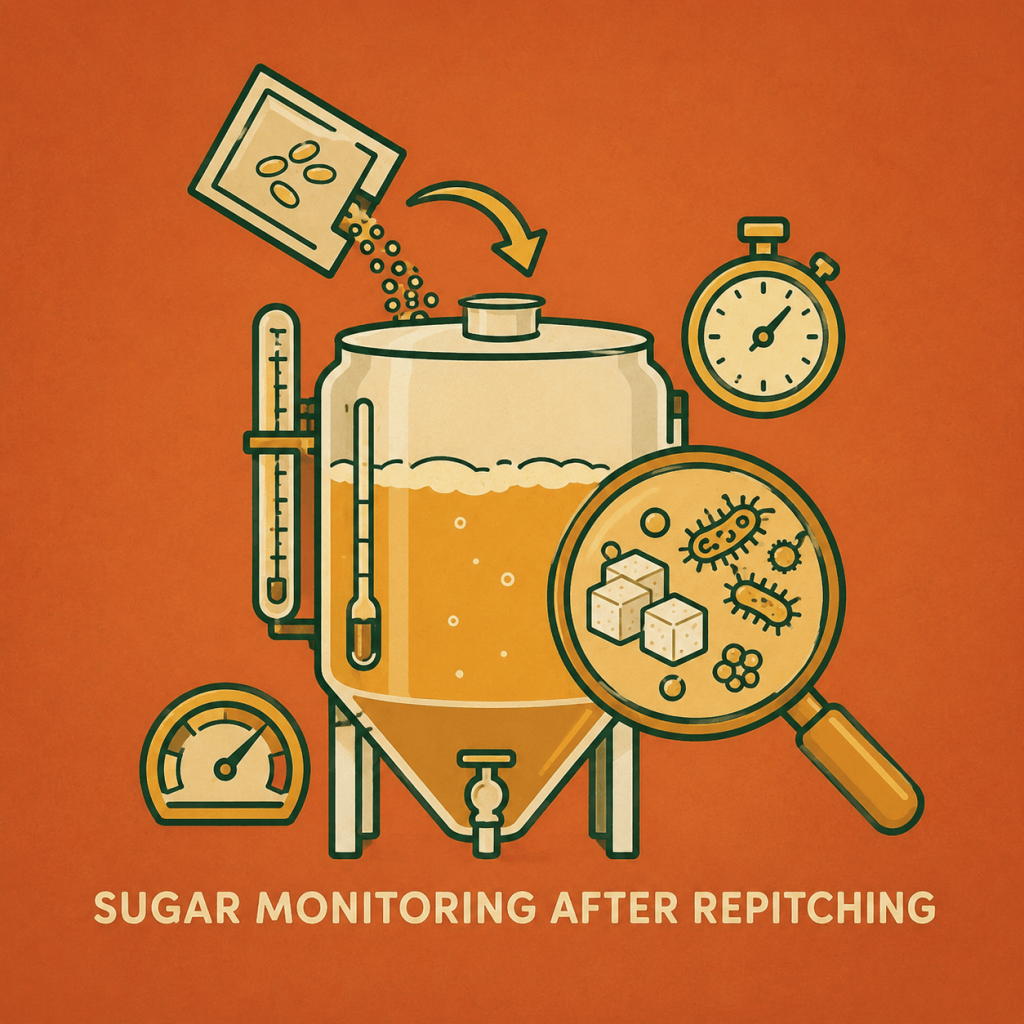
Fermentable sugar monitoring can show whether sugar consumption starts again after repitching. This gives faster feedback. If the fermentable sugar level decreases, the new yeast is active. If it does not change, the problem may be more serious.
For example, the beer may have too much alcohol for the yeast strain. The temperature may still be too low. Nutrients may be missing. The pH may be stressful. Or the yeast may not be able to ferment the remaining sugar profile.
This information helps the brewer decide whether to adjust the process, repitch with another yeast, or stop trying to force further fermentation.
Reducing tank time and uncertainty
Slow or stuck fermentations create production problems. Tanks stay full longer than planned. Packaging dates move. Other beers may be delayed. The brewer is forced to make decisions with incomplete information.
Fermentable sugar measurement reduces this uncertainty. It gives a direct view of fermentation progress. The brewer can see whether the process is moving, slowing down, or stopped.
This is especially useful when a brewery is busy and tank capacity is limited. It helps avoid waiting “just in case” when nothing is changing. It also helps avoid packaging too early when fermentable sugars are still present.
Avoiding problems after packaging
If a beer is packaged with too much fermentable sugar, fermentation can continue later. This can lead to overcarbonation, gushing, pressure problems, flavour changes, or inconsistent product quality.
This risk is higher when fermentation was already problematic. A beer that needed repitching has shown that the process was not fully under control. Before packaging, the brewer needs extra confidence that the beer is stable.
Measuring fermentable sugars before release gives this extra confidence. It helps confirm whether the remaining sugar level is low enough and whether the beer is unlikely to continue fermenting in package.
Better yeast management over time
Fermentable sugar data also helps improve future yeast management. It can show patterns between batches. For example, a brewery may discover that a certain yeast strain often slows down at a specific sugar level, or that a certain recipe requires a higher pitching rate.
It can also help evaluate repitching practices. If yeast from later generations regularly leaves more fermentable sugar behind, this may show that yeast health is declining. If fermentation improves after changes in oxygenation, nutrient addition, or pitching rate, sugar data can help confirm that improvement.
Why it gives an edge
When yeast needs to be repitched, the brewer is already dealing with a risky situation. The most important question is not only “What is the gravity?” but “Is there still fermentable sugar left, and is the yeast consuming it?”
Fermentable sugar monitoring gives a direct answer. It helps decide whether repitching is needed, whether it worked, and whether the beer is safe to package.
For breweries that want better process control, this is a major advantage. It turns repitching from a guess into a controlled decision based on real fermentation data.
 Nederlands
  English